Tuesday, May 29, 2007
Leaders or the led?

Sunday, May 06, 2007
Leaders who happen to be women


Christiane, a CNN war correspondent and the winner of several awards, spoke about the women in the Bankan and other war torn areas who have leadership thrust upon them. These women have to speak up to survive; they have to run with leadership because the alternative is death. She spoke passionately but without sentiment. She was quite magnetic. Answering a question from the audience about how she juggles parenthood and globe-trotting to war torn areas Christiane was quite candid – “I live with constant fear but I’ve learnt to manage it…And the fear factor has multiplied in the last seven years after my son was born…Being a parent comes with certain responsibilities the most basic of them being trying to stay alive…these days I try not to be away from home for long durations if I can help it.” Here is a woman of the world who has risen above her gender. It is women like Christiane who make gender insignificant, and it is increasingly women like her that I’m inspired by and drawn towards.
Queen Latifah came on stage to the strings of “When you’re good to mama, mama’s good to you”. Unlike Christiane she spoke not about the world but about herself. She talked about her childhood in a poor neighborhood in Maryland, her parents, her brother and how she got to where she is today. She was funny, self-effacing and quite honest. There were no rhetoric, no Hollywood-style gimmicks and absolutely no self-propaganda. She let the audience meet the poor black girl who made it big because she never really tried to do anything she was not good at. The audience gave her a standing ovation and no one deserves it more than her.
When life decides to put me in my place it does not do so by half-measures. Not only was I proved wrong by the speakers of the day but, contrary to my expectations, the fare served for lunch was also below par!
Saturday, March 24, 2007
On sense, sensibility and sentimentality

Anyone who has watched that somewhat tawdry, sentimental kitsch of a Tamil movie called Kandukonden Kandukonden can be said to be acquainted with the broad storyline of Sense and Sensibility. The story is about two sisters, refined and accomplished, who are temperamentally polarized between an impulsive, passionate disposition of one and the moderate, sober, deliberate nature of the other. The former – Marianne Dashwood – represents Sense and the latter – Elinor Dashwood – represents Sensibility. The story, while tracing the romantic pursuits and consequent heartaches of the sisters, indirectly poses a question on the superiority between the two traits. Does Sense triumph or does Sensibility? It might be said that since Marianne loved deeply, was hurt deeply by the inconstancies of the object of her affections and eventually reconciled to marry an older man (Mammooty!) whom she had to learn to love but who had loved her through all her excesses, she had, in fact, lost. Elinor, on the other hand, is the only person in the book who ends up marrying her first choice, albeit after much confusion and heartaches that were borne with a dignity far beyond her age. Therefore it might be argued that Sensibility triumphed. But the author does not pronounce any such black-and-white judgments but instead leaves the reader to form their own ideas.
What I liked best about Sense and Sensibility was, of course, the sheer beauty of the prose. Jane Austen is ruthless when it comes to exposing characters she is not fond of and she does this with such mockery and with such clever use of language that it delights the reader in its wickedness. I was astounded to find out that the book was written when Austen was nineteen. How did someone so young come to know so much, to understand so much about the society in which she lived and learn to articulate it so perfectly? At nineteen I was still trading Mills & Boons with my girlfriends!
For instance, consider the following description of the sisters’ half-brother John Dashwood and his wife Fanny, who throw the sisters and their mother out of the family home (roles played by Raguvaran and Anita Ratman in the tamil version. Ugh).
“ He was not an ill-disposed young man, unless to be rather cold hearted, and rather selfish, is to be ill-disposed: but he was, in general, well respected; for he conducted himself with propriety in the discharge of his ordinary duties. Had he married a more amiable woman, he might have been made still more respectable than he was; he might even have been made amiable himself; for he was very young when he married, and very fond of his wife. But Mrs. John Dashwood was a strong caricature of himself; more narrow-minded and selfish. ”
Coming from a conservative tam-bram family, I could draw many parallels to life as it used to be when I was growing up in Mylapore. The emphasis on refinement in women as being the most ‘marriageable’ trait, the fact that social intercourse was the chosen vehicle for forming marriage alliances, the sentimentality of women and men alike, the overriding unabashed place of monetary affairs in the center of marriage negotiations - these were as much a reality in the Mylapore Mami’s life as they were in the fictional Marianne’s. As I read (or heard) Sense and Sensiblity I could connect to it from deep down. In the lives of Marianne and Elinor I saw the lives of my grandmothers and aunts. As pre-globalization women, they were but a cog in the Mylapore social wheel - “cultivating” themselves by learning to sing and dance and trying very hard to uphold modesty.
This book made my long drive to work well worth it and is second only to The Paycheck!
Sunday, February 11, 2007
Trite
Tuesday, January 16, 2007
This above all: to thine own self be true
I’ve been listening to ‘The age of innocence’ (by Edith Wharton) on my way to work and driving has never been so much fun, with my finishing a book a week! I’ve particularly taken to listening to the classics, as these are books I take the longest to read in paperback. ‘The age of innocence’ follows ‘A room with a view’ which follows ‘Stumbling upon happiness’ (not a classic, not even that good come to think about it). Given the subjects I’ve been listening to all month – the human brain's capacity for self-deception; enforcing conformity being society’s primary purpose; prudishness; perception and its loopholes and so on – its little wonder that Shakespeare’s ‘To thine own self be true’ keeps popping up in my conscious mind ever so often. In the midst of busy workday I pluck out this line, examine it, and although I am two hours behind schedule in finishing a particular task, here I am writing this blog.
It’s funny, really, but given that we spend so much time with ourselves it seems to me a fundamental flaw in design that one can lie to the one person one cannot escape from. If the man above was a software engineer he would have made the reality object immutable because, as it stands now, nothing is as easy, nothing is as self-serving as pretending that one is what one isn’t.
I knew this woman once who told elaborate stories about how she could not do the one thing she wanted to do – paint. She had it rehearsed so well that it was near-impossible to find a chink in her armor, to make her see that the fabrications were a mechanism to avoid reality because reality is bitter; reality means struggling with oneself and facing up to what a slacker, what an escapist, what a lying, deceptive piece-of-goods one really is. That kind of admission hurts. It is said that meditation, when done near-continuously, reveals to one the disastrous traps of ones mind, and many a strong-willed person have been reduced to tears at the harsh, unsolicited clarity that they have had to look in the face. As for this woman, she eventually honed her stories into a moral-superiority thing, labeling her inaction as ‘sacrifice, in the name of family’ – which is good and virtuous, especially in a woman.
It happened that one day we were lunching together when a mutual acquaintance walked in on us. We had not met her in a long time and invited her to join us. Over coffee, we found that she was a cartoonist now, freelancing with several newspapers and the recipient of many awards. At the very moment this fact was revealed, I saw a look of red-hot jealousy pass through the eyes of the erstwhile painter. It was shrouded and stifled instantly but at that moment it was like looking into her soul. And I did not like what I saw there. Minutes after the cartoonist had left the only thing my friend could bring herself to say was “Now that she is divorced I suppose she has all the time in the world to spend on herself.” I could see it so clearly. Her mind was hunting for an escape clause, some salve with which to soothe her aching ego, some proof that the cartoonist had paid a heavier price for her success than was warranted and that she was better off for not rising to the bait.
My friend, the painter, is as normal, or abnormal, as any one of us. She could be me. Or you. We are all mostly like this, authors of our own failures, passing it off as virtue or bad luck or destiny. No one is fooled but us; No one stands to lose but us, or even cares about our loss. They are all busy lying down on the bed of lies they have made for themselves.
These are the things that occupy my mind as I drive to work everyday, invariably late for my meetings and telling myself - lying to myself - that chronic unpunctuality does not matter in the bigger scheme of things.
I desperately need to listen to some whodunits.
Thursday, December 21, 2006
Sniff, Sniff
It happened today. Conscious of a certain pair of smelly gym socks I decided to mitigate it by eating my lunch in my cubicle in the hope that the pungent smell of indian masalas would compensate. Fat chance! When the boss man dropped by for a chat he sniffed and said "It is hot in here!”. I had to gag the impulse to say "If by that you mean that something is smelly around here, let me assure you that it is not me but a pair of malodorous socks."
But I stopped myself. Owning to smelly feet is as fatal to career progression as owning to smelly armpits.
Thursday, October 12, 2006
On a lighter note....
Some primal termite knocked on wood
And tasted it, and found it good,
And that is why your Cousin May
Fell through the parlor floor today.
-Ogden Nash
I should really stop quoting poetry as an alternative to writing a real blog!
Wednesday, October 11, 2006
Ezra Pound
And the nights are not full enough
And life slips by like a field mouse
Not shaking the grass.
- Ezra Pound
Wednesday, August 16, 2006
Gainfully unemployed
I was relieved.
To be free of toil for even a few days in this glorious weather is a blessing. A paid vacation with medical insurance? It’s a sign that the man upstairs has chosen me on this turn of the roulette.
Now, in how many ways can one be idle?
Lounge on the banks of the Charles with book, beer and blanket – Wednesday
Lounge in Boston Common with book, beer and blanket – Thursday
Heated yoga, hair salon – Saturday
……
That’s my stance and I’m sticking to it!
Thursday, June 15, 2006
Saturday, June 10, 2006
The lunar pull of Japan

Japan, in my eyes, is modern and quaint, poetic and practical, the land of rock gardens and pachinko parlors, of Starbucks lattes and moss burgers. Completely beautiful in its contrasting characteristics.
‘The Lady and the Monk: Four Seasons in Kyoto’ by Pico Iyer is an excellent travelogue that manages to catch the pulse of this enchanting country. It manages to be lyrical, exploratory and profound at the same time. Which is a tough act for a travel book.
Sunday, May 21, 2006
Da Vinci Mania

[Onion - litter in crash site]
Apparently tourism to France is 'sky high' after the release of the much-hyped movie.
Methinks this badly written book and its only-slightly-better movie version has traveled a long way indeed. Just goes to prove that life is not a meritocracy.
Wednesday, May 17, 2006
Vikram Seth on being Bi
I'm glad I like them both but still
I wonder if this freewheeling
Really is an enlightened thing,
Or is its greater scope a sign
Of deviance from some party line?
In the strict ranks of Gay and Straight
What is my status: Stray? Or Great?
Seth was the Aamir Khan of my teens. Years have passed, much has changed in the world and yet, and yet, when I met him at the reading of his latest book (Two Lives) a few months ago, I became once again the schoolgirl who skipped school to finish reading his tome. A few weeks ago I discovered his bisexual leanings that, in hindsight, was always conspicuous in his books and poems.
How deceitful are teenage hormonal surges!
Saturday, May 13, 2006
As the poets have mournfully sung
Death takes the innocent young,
The rolling-in-money,
The screamingly-funny,
And those who are very well hung.
-- W. H. Auden
It takes an Auden to be tongue-in-cheek about death!
Wednesday, May 10, 2006
A Shinagawa Monkey
Tuesday, May 09, 2006
Pursuing Happiness
Every week I discover at least one article that I think is profound, intriguing or just beautifully written. February’s issue had an article about the pursuit of happiness that made interesting read.
There was a time when I had fancied myself as being unhappy and went around spouting such nonsense as “Sorrow is more profound than happiness”. Now that I'm older and wiser by a fraction, I am gobble smacked that I am not skipping merrily about. My “set point” is perhaps not given to happiness. To find out what I’m talking about read the article. I promise you’ll thank me for it!
Monday, May 08, 2006
Feminist rant
Despite fear of sounding like a feminist I have to ask -
What about fathers? Don't fathers count?
My issue is not that such a study was made and reported. I am only nervous about the idealization of motherhood and of any mention of ‘penmai’ and ‘thaimai’ as a virtue. I see this whole deifying of motherhood as a function of the society we live in. Indian society, especially, comes down pretty heavily on mothers by weighing in on their feelings of guilt. Some other cultures may be a tad lenient but the difference is marginal. The bottom line is always that, an woman is expected in any society to put nurturing right up there in her list of priorities. Contrary to popular belief psychologists will tell you that the mothering instinct, like any other skill, does not come naturally to all women.
Nancy Friday speaks about this syndrome in the book "My mother, myself". Friday talks about how women are, from birth, taught to believe that their success and failure is hinged on whether they are good mothers to their children or not. This, according to Friday, is psychologically the most limiting factor to women's growth. Because they cannot think of themselves in any larger context apart from that of a mother they never let their children grow emotionally, preferring instead to keep them tied to themselves.
By idealizing/idolizing motherhood we also deny them the right to make mistakes and learn from them. We set them up in a pedestal from where the only place they can go is down.
Thursday, May 04, 2006
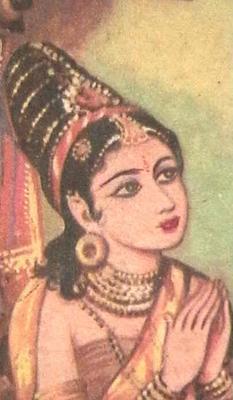
Girl Power (Illustrations by Manian)
Wednesday, May 03, 2006
Ponniyin Selvan & my mother
Now mom can no longer complain that I have poor literary taste - Ponniyin Selvan has bridged the divide between my literary gene and its blueprint!
Tuesday, May 02, 2006
Wondering Minstrels
Some years ago, I’d heard that the duo who run the show -Thomas Abraham and Martin DeMello- were planning on holding poetry readings in bookstores across Bombay. Wonder what became of that idea.
Warning: I would recommend you subscribe to their mailing list or at least wear sunglasses if you’re browsing their site. The blue can be blinding!